9.1 จากการเคลื่อนที่เชิงเส้นสู่การหมุน: ทำไม ไม่พอ?
สำหรับวัตถุจุด การบอกตำแหน่ง หรือ เพียงพอที่จะอธิบาย configuration ของระบบได้มากพอสมควร แต่สำหรับ rigid body ที่หมุนรอบแกนคงที่ จุดต่าง ๆ บนวัตถุมีตำแหน่งเชิงเส้นต่างกันตลอดเวลา แม้วัตถุทั้งชิ้นจะมี “สถานะการหมุน” ร่วมกันเพียงหนึ่งค่า
เราจึงเลือกเส้นอ้างอิงที่ติดกับวัตถุและกำหนด ตำแหน่งเชิงมุม
ใน fixed-axis treatment เราประกาศทิศบวก เช่น ทวนเข็มนาฬิกาเป็นบวก แล้วให้ เป็น signed scalar.
Continuity warning จาก Chapter 8
ใน Chapter 8 สัญลักษณ์ หมายถึง oscillation angular frequency ซึ่งเป็น parameter บวกของ SHM. ใน Chapter 9 เราจะใช้ เป็น angular velocity ของการหมุน ซึ่งใน fixed-axis treatment อาจเป็นบวกหรือลบได้. สัญลักษณ์เหมือนกัน แต่ physical quantity ไม่ใช่สิ่งเดียวกัน
แหล่งอ้างอิงที่เปิดตรวจ: Young & Freedman, 15e SI, Ch.9 §9.1, pp.300–304; Serway & Jewett, 10e, Ch.10 §10.1, pp.250–251; Knight, 4e, Ch.12 §12.1, p.295 onward.
9.2 Radian ไม่ใช่เพียงหน่วยอีกแบบหนึ่ง
ให้จุด อยู่ห่างแกนหมุนเป็นระยะตั้งฉาก และเคลื่อนตาม arc length . ถ้ามุมวัดเป็น radian
หรือเมื่อเลือก zero ของ arc และ angle สอดคล้องกัน
นี่คือเหตุผลเชิงคณิตศาสตร์ว่าทำไม rotational calculus ใช้ radian: ความสัมพันธ์เชิงเส้นนี้ไม่มี conversion factor แทรกอยู่
ถ้าใช้ degree แล้วเขียน ตรง ๆ จะผิด เพราะต้องมี factor .
Math box — radian คือ ratio
เป็นอัตราส่วนของความยาวสองปริมาณ จึงไม่มีมิติพื้นฐาน แม้ในการสื่อความหมายทางฟิสิกส์เรายังคงเขียน “rad” เพื่อบอกชนิดของ angle
แหล่งอ้างอิง: Young §9.1; Serway §10.1 ซึ่งเตือนโดยตรงให้ใช้ radian ใน rotational equations.
9.3 Angular velocity และ angular acceleration
Average angular velocity:
Instantaneous angular velocity:
และ angular acceleration
ดังนั้น interpretation จาก Part 1 ย้ายมาได้ตรงตัว:
slope ของกราฟ – คือ ,
slope ของกราฟ – คือ ,
signed area ใต้กราฟ – คือ ,
signed area ใต้กราฟ – คือ .
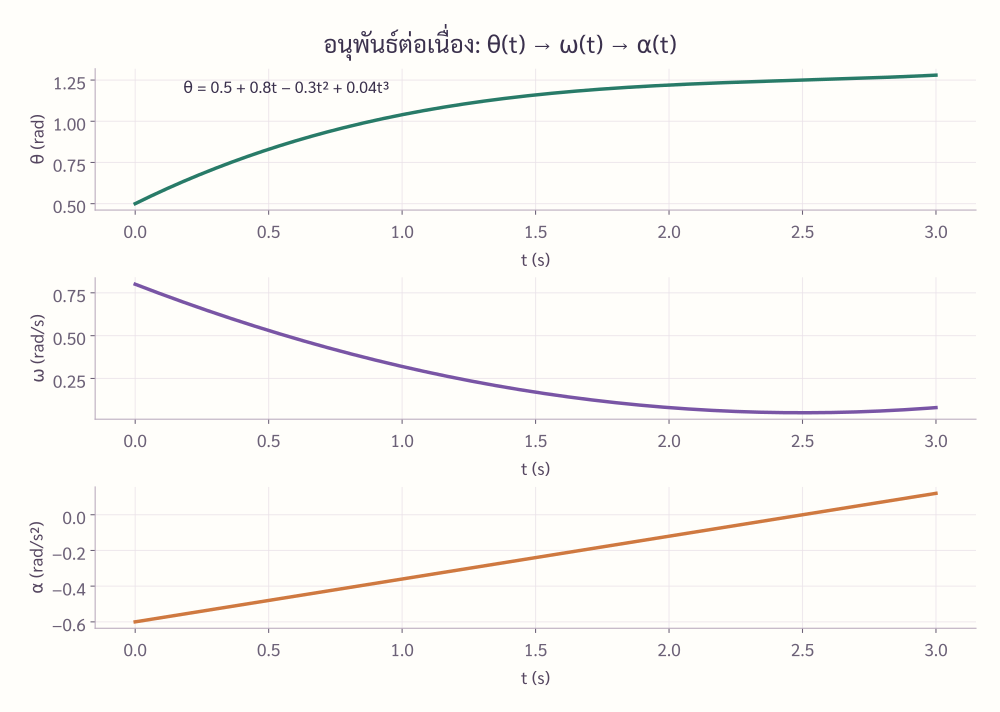
9.4 Constant angular acceleration: สูตรต้องเกิดจาก calculus
ถ้า คงที่
integrate จาก ถึง :
แล้ว integrate :
อีกวิธีใช้ chain rule
ดังนั้น
และเมื่อ คงที่
ความหมายทางคณิตศาสตร์
สมการ constant- ไม่ใช่ชุดสูตรใหม่ที่ต้องจำแยกจาก kinematics เชิงเส้น แต่เป็นผลจาก differential definitions ชุดเดียวกัน เพียงเปลี่ยน coordinate จาก เป็น .
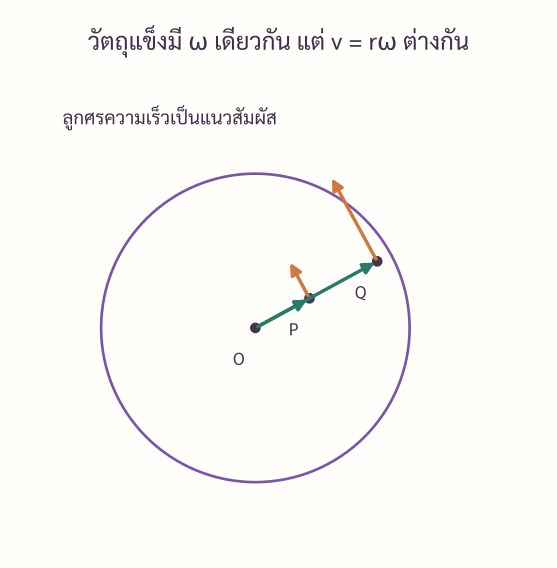
9.5 วัตถุแข็งชิ้นเดียว: same , different
สำหรับ rigid body หมุนรอบแกนคงที่ จุดทุกจุดบนวัตถุมี เดียวกัน แต่ linear motion ขึ้นกับระยะจากแกน
จาก เมื่อ คงที่
และ
ส่วน radial acceleration magnitude คือ
ชี้เข้าหาแกนหมุน
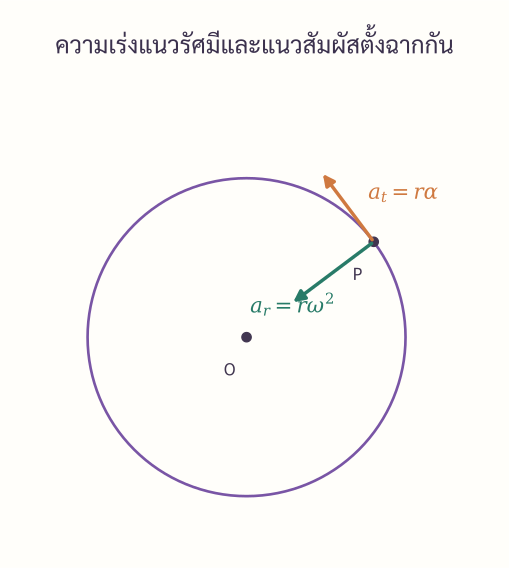
แหล่งอ้างอิงสมการ: Young §9.3, pp.307–309.
9.6 Angular velocity เป็น vector อย่างไร?
สำหรับ fixed-axis rotation ให้เวกเตอร์ ชี้ตามแกนหมุนด้วย right-hand rule:
งอนิ้วตามทิศการหมุน
นิ้วหัวแม่มือชี้ทิศ .
Magnitude คือ angular speed .
Knight แยกประเด็นนี้ไว้อย่างมีประโยชน์: fixed-axis rotation ใช้ signed scalar ได้เหมือน 1D kinematics แต่เมื่อพูดถึงทิศของแกนใน 3D ต้องใช้ vector.
Scope caveat
เราจะไม่ใช้ finite angular displacement ใน arbitrary 3D เป็น “ordinary vector” แบบไม่ระวัง. บทนี้เน้น fixed-axis rotation; fully general 3D rigid-body kinematics อยู่นอกขอบเขต
แหล่งอ้างอิง: Young §9.1 angular-velocity vector; Knight §12.10, pp.317–319.
9.7 Cross product: เริ่มจากความหมาย ไม่ใช่ determinant
ให้ และ ทำมุม เมื่อวาง tail-to-tail.
Magnitude ของ cross product คือ
ทิศตั้งฉากกับระนาบของ ตาม right-hand rule.
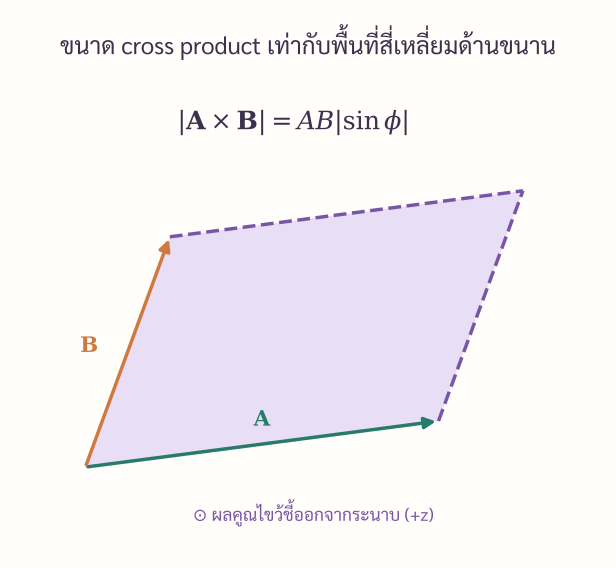
สิ่งสำคัญ:
ดังนั้น order matters.
อีก interpretation หนึ่งคือ
จึงมอง cross product เป็นการวัด “perpendicular effectiveness” ได้ ซึ่งเป็นเหตุผลว่าทำไมมันเหมาะกับ torque.
สำหรับ components:
แต่ determinant เป็นเพียง เครื่องมือคำนวณ ไม่ใช่นิยามทางฟิสิกส์
แหล่งอ้างอิง: Young §1.10 Vector Product; Serway §11.1; Knight §12.10.
9.8 Vector kinematics compact form
ถ้า วัดจากจุดบน fixed axis ไปยังจุดหนึ่งบน rigid body
ทำไมสมการนี้ถูก?
magnitude: ซึ่งตรงกับ ,
direction: cross product ให้ tangent direction โดยอัตโนมัติ.
สมการนี้เป็น derived synthesis จาก relations ที่เปิดตรวจแล้ว ไม่อ้างเป็น textbook equation number ใหม่
Advanced Vector Box — acceleration
Differentiate
ได้
แทน :
พจน์แรกเป็น tangential contribution และพจน์ที่สองให้ radial/inward contribution
Teacher note
นี่เป็น advanced synthesis box ไม่ใช่สมการที่ต้องบังคับจำใน 80-minute core. จุดประสงค์คือให้เด็กที่พร้อมเห็นว่า scalar relations หลายบรรทัดรวมเป็น vector equation เดียวได้อย่างไร
9.9 Torque: “แรงเท่าไร” ยังไม่พอ
ลองผลักประตูด้วยแรงเท่ากัน:
ใกล้บานพับ → เปิดยาก
ไกลบานพับ → เปิดง่าย
ผลักตามแนวที่ line of action ผ่านบานพับ → ไม่หมุนเลย
ดังนั้น rotational effectiveness ของแรงต้องขึ้นกับ
force ,
ตำแหน่งที่แรงกระทำเทียบกับ reference point,
orientation ของ force.
กำหนด torque ของแรงเกี่ยวกับจุด :
คือเวกเตอร์จาก ไปยังจุดที่แรงกระทำ
Magnitude:
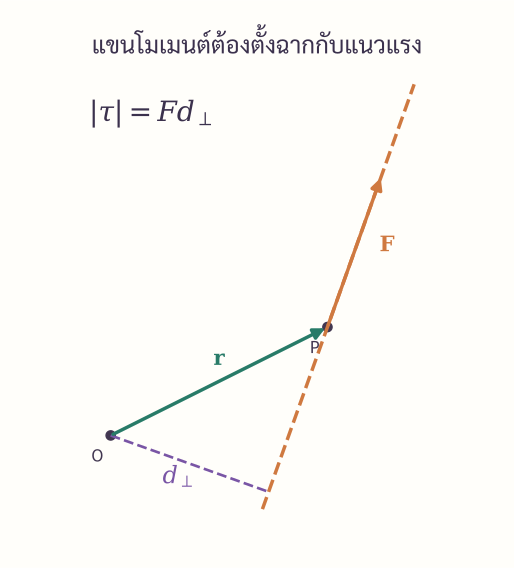
แหล่งอ้างอิง: Young Ch.10 §10.1, pp.330–332; Serway §11.1.
9.10 สามภาพของ torque ที่ต้องเชื่อมให้เป็นเรื่องเดียว
จาก geometry
โดย คือ moment arm / lever arm: ระยะตั้งฉากจาก ไปยัง line of action.
ดังนั้น
ทั้งสามรูปคือ physics เดียวกัน:
เหมาะเมื่อรู้ angle,
เหมาะเมื่อแยก force components ง่าย,
เหมาะเมื่อเห็น line of action ชัด.
ถ้า line of action ผ่าน :
แม้ .
Non-negotiable wording
อย่าพูดว่า “แรงนี้มี torque เท่าไร” โดยไม่ระบุ point/axis หากบริบทไม่ชัด. Torque ไม่ใช่ property ของ force เพียงอย่างเดียว
แหล่งอ้างอิง: Young §10.1; Serway §10.4; Knight §12.5; Tipler §9-4.
9.11 2D signed torque และ component form
ถ้าระบบอยู่ใน -plane,
ดังนั้น
จึงได้
ถ้าเลือก ออกจากหน้าเป็นบวก:
counterclockwise tendency → ,
clockwise tendency → .
นี่ไม่ใช่กฎจำรูปภาพแยกต่างหาก แต่เป็น consequence ของ cross-product orientation.
9.12 Net torque และ torque about an axis
สำหรับหลายแรงเกี่ยวกับ reference point เดียวกัน :
ห้ามใช้ ที่อ้างคนละ origin ใน sum เดียวกัน
ถ้าการหมุนถูก constrain ให้อยู่รอบ axis ที่มี unit vector สิ่งที่มีผลต่อการหมุนรอบแกนนั้นคือ component ของ torque ตามแกน
นี่คือ scalar triple product และเป็นการใช้ dot product จาก Chapter 6 ร่วมกับ cross product ของ Chapter 9.
Math interpretation
สร้าง “rotational-effect vector” ก่อน แล้ว dot กับ เพื่อถามว่า rotational effect ส่วนนั้นอยู่ตาม allowed axis มากเท่าไร
Young ระบุชัดว่าสำหรับแกนคงที่ที่กำหนดไว้ เฉพาะ torque component ตามแกนนั้นที่เกี่ยวข้อง
9.13 Torque ขึ้นกับจุดอ้างอิงอย่างไร?
ให้ อยู่จาก ด้วยเวกเตอร์ .
สำหรับแรงที่ ,
ดังนั้น
จึงได้
ผลนี้อธิบายทันทีว่า
ถ้า , torque โดยทั่วไปเปลี่ยนเมื่อเปลี่ยน origin,
ถ้า , net torque ไม่เปลี่ยนภายใต้ origin shift แบบ translation.
สมการนี้เป็น original vector derivation จาก torque definition ไม่อ้างเป็น textbook equation number
9.14 Force couple: zero net force แต่หมุนได้
Force couple คือแรงสองแรงขนาดเท่ากัน ทิศตรงข้าม และกระทำคนละ line of action.
แต่ torque รวมอาจไม่เป็นศูนย์
สำหรับแรงขนานกันที่ separated by perpendicular distance :
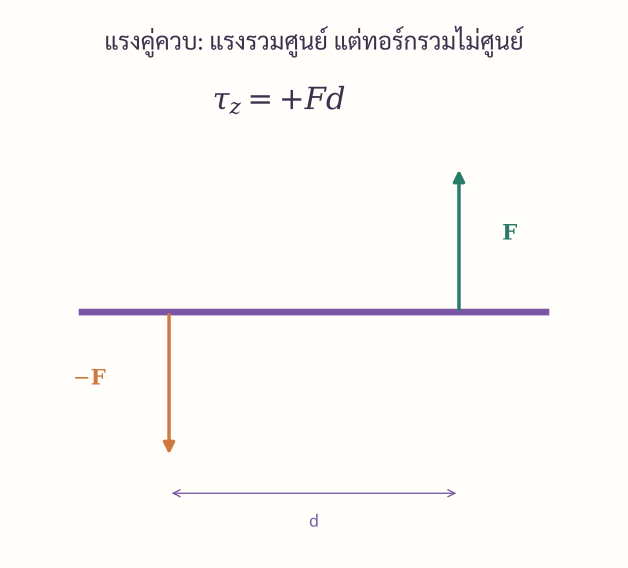
จาก origin-shift formula เมื่อ ,
ดังนั้น torque ของ pure couple ไม่ขึ้นกับการเลื่อน reference origin.
Olympiad insight
“Net force = 0” ไม่ได้แปลว่า “ไม่มี rotational effect”. ในทางกลับกัน “net torque = 0” ก็ไม่ได้แปลว่า full mechanical equilibrium ถ้า net force ยังไม่เป็นศูนย์
9.15 สิ่งที่ Chapter 9 ยังไม่ตอบ — สะพานสู่ Chapter 10
ตอนนี้เรารู้วิธีคำนวณ torque แล้ว แต่ยังมีคำถามสำคัญ:
ถ้า rigid bodies สองชิ้นได้รับ torque เท่ากัน จะมี angular acceleration เท่ากันหรือไม่?
คำตอบคือ ไม่จำเป็น
วัตถุที่มีมวลกระจายไกลแกนกับใกล้แกนตอบสนองต่อ torque ไม่เหมือนกัน แม้มวลรวมเท่ากัน
ปริมาณที่จะวัด “rotational inertia” ของ mass distribution คือ moment of inertia ซึ่งเป็นแกนหลักของ Chapter 10.
ดังนั้น Chapter 9 จงใจหยุดก่อนสมการ .
9.16 Strategic method selection
มี → differentiate เพื่อหา .
มี → integrate เพื่อหา change in แล้ว integrate ต่อถ้าต้องการ .
rigid body point at radius → ใช้ , , , .
torque geometry ชัด → ใช้ moment arm .
มี vectors/components → ใช้ .
ต้องการ torque about one specified axis → project ด้วย .
เปลี่ยน reference point → ใช้ origin-shift reasoning; อย่าคิดว่า torque invariant โดยอัตโนมัติ.
ระบบมี equal-and-opposite separated forces → ตรวจว่าเป็น couple หรือไม่.
9.17 Worked Examples
ตัวอย่าง 9.1 — จาก ไปสู่ และ
ให้
ใน SI-radian convention.
หา
และ
Interpretation: ที่เวลาซึ่ง แต่ , วัตถุยังหมุนทิศบวกแต่กำลังลด angular speed.
Sanity check: หน่วยของ coefficient ต้องทำให้แต่ละ term ของ dimensionless/radian-consistent.
ตัวอย่าง 9.2 — Integral beats memorization
กำหนด
และ .
Integrate:
แล้ว
โจทย์นี้ constant- formulas ใช้ไม่ได้ตรง ๆ เพราะ เปลี่ยนตามเวลา.
ตัวอย่าง 9.3 — จุดสองจุดบน disk เดียวกัน
Disk มี angular speed และ angular acceleration . จุด อยู่ที่ และ อยู่ที่ .
ทั้งสาม ratio มาจาก radius scaling แม้ ของสองจุดจะเท่ากันทุกขณะ.
ตัวอย่าง 9.4 — Torque ด้วย cross product
ให้
และ
ดังนั้น
ทิศ หมายถึง counterclockwise tendency ตาม convention.
ตัวอย่าง 9.5 — Lever arm ทำให้ geometry สั้นกว่า components
ประแจยาว ถูกออกแรง ทำมุม กับแนวด้าม.
แทนที่จะแตก components ทั้งหมด ใช้
จึง
ถ้าเป้าหมายคือ maximize torque เมื่อ fix:
ดังนั้น maximum ที่ .
ตัวอย่าง 9.6 — Couple และ reference point
แรง และ มี line of action ห่างกัน .
Net force:
เลือก origin ใดก็ได้; จาก origin-shift relation torque ไม่เปลี่ยน.
Magnitude:
นี่คือระบบที่มี pure rotational tendency โดยไม่มี net translational force.
9.18 Main Exercise — 30 ข้อ
โจทย์ 9.1–9.30 เป็น original authoring ของโครงการ และตั้งใจให้ไม่มีข้อใดเป็น direct substitution ล้วน
Concept / Sign / Reference-Point Control
โจทย์ 9.1 — สองความหมาย
นักเรียนกล่าวว่า “ใน Chapter 8 เป็นบวกเสมอ ดังนั้น angular velocity ใน Chapter 9 ต้องเป็นบวกเสมอด้วย” จงวิจารณ์ โดยยกตัวอย่าง motion ที่ ใน fixed-axis convention และอธิบายว่าเหตุใด SHM angular frequency กับ rotational angular velocity จึงไม่ใช่ปริมาณเดียวกัน
โจทย์ 9.2 — Why radians?
เริ่มจาก arc geometry แสดงว่าถ้า วัดเป็น degree, relation ระหว่าง กับ ต้องมี conversion factor. จากนั้นอธิบายว่าทำไม derivative มีรูปเรียบง่ายที่สุดเมื่อ เป็น radian.
โจทย์ 9.3 — Nonzero force, zero torque
ให้ force กระทำที่จุดหนึ่งบน rigid body. สร้างอย่างน้อยสอง geometric conditions ที่ทำให้ torque เกี่ยวกับจุด เป็นศูนย์ และอธิบายด้วยทั้ง cross-product และ line-of-action language.
โจทย์ 9.4 — ไม่ใช่ full equilibrium
ยกตัวอย่างระบบแรงในระนาบที่ net torque about เป็นศูนย์ แต่ net force ไม่เป็นศูนย์. อธิบายว่าเหตุใดห้ามสรุปว่าวัตถุอยู่ใน mechanical equilibrium.
Angular Kinematics + Calculus
โจทย์ 9.5 — Polynomial angular motion
ให้ โดย . หา และหาเวลาบวกที่ angular velocity มี extremum. แปลความหมาย sign ของ ก่อนและหลังเวลานั้น.
โจทย์ 9.6 — Variable angular acceleration
ให้ และ . หา และ . ตรวจ limit เมื่อ และอธิบายว่าทำไม angular velocity เข้าใกล้ค่าคงที่แต่ angular displacement ยังโตต่อ.
โจทย์ 9.7 — Piecewise drive and brake
disk เริ่มจาก rest. ช่วง มี และช่วง มี . สร้างกราฟ และหา total angular displacement ถึง จาก area reasoning โดยไม่เริ่มจากสูตรสำเร็จ.
โจทย์ 9.8 — Same rigid body, different radii
จุด อยู่ที่ และ . ที่ขณะหนึ่ง . เปรียบเทียบ และ total acceleration magnitudes ของสองจุด. ระบุสิ่งใดเท่ากันจริงและสิ่งใดไม่เท่ากัน.
โจทย์ 9.9 — Turning direction
ให้ , . หาเวลาที่วัตถุหยุดชั่วขณะและกลับทิศ. หา angular displacement ตั้งแต่ ถึงขณะกลับทิศ และอธิบายเหตุใด angular distance หลังจากนั้นไม่เท่ากับ signed displacement.
โจทย์ 9.10 — Inverse graph problem
กราฟ เป็นเส้นตรงจาก ถึง . หา , net angular displacement, total angle traveled และเวลาที่เปลี่ยนทิศ.
โจทย์ 9.11 — Point acceleration vector
rigid disk มี เกี่ยวกับ . จุดหนึ่งมี ณ ขณะ . ใช้ทั้ง component reasoning และ advanced vector formula หา . แสดงว่า radial term โตเป็น แต่ tangential term คงที่.
โจทย์ 9.12 — Infer
วัตถุหมุนรอบแกนคงที่ผ่าน origin. ณ จุด วัดได้ และทราบว่าแกนตั้งฉากกับ -plane. หา . จากนั้นทำนาย velocity ที่ และตรวจ orthogonality .
Cross Product + Torque Geometry
โจทย์ 9.13 — Full 3D torque vector
ให้ และ . หา , magnitude และ component ตาม axis .
โจทย์ 9.14 — Three equivalent torque methods
force magnitude กระทำที่ปลาย rod length ทำมุม กับ rod. จงคำนวณ torque magnitude สามวิธี: , , , และแสดง algebraically ว่าตรงกัน.
โจทย์ 9.15 — Unknown line of action
แรงขนาด ให้ torque magnitude about . จุด application อยู่ห่าง ระยะ . หา possible angle(s) ระหว่าง กับ และระบุเงื่อนไขที่ข้อมูลไม่มี solution จริง.
โจทย์ 9.16 — Multiple planar forces
ที่จุด มี force ; ที่ มี force ; ที่ มี force . หา net torque about origin, net force และอธิบายว่าจะคาดหวัง pure translation, pure rotation หรือทั้งสองอย่างในเชิง tendency โดยยังไม่ใช้ .
โจทย์ 9.17 — Torque about an oblique axis
ให้ และ . หา torque vector แล้วหา torque component about axis .
โจทย์ 9.18 — Choose a reference point strategically
แรงสามแรงกระทำบน triangular frame. จงเสนอ reference point ที่ทำให้แรงอย่างน้อยหนึ่งแรงมี torque เป็นศูนย์โดยทันที และอธิบาย general principle จาก line of action. จากนั้นเปรียบเทียบความยากของการเลือก origin สองแบบ.
โจทย์ 9.19 — Origin dependence proof
เริ่มจาก และพิสูจน์ . จากนั้นระบุเงื่อนไขที่ torque invariant ต่อ translation ของ origin.
โจทย์ 9.20 — Couple from two forces
แรง ที่ และ ที่ . หา net force และ torque about (i) origin, (ii) point . แสดงผลลัพธ์ torque เหมือนกันและตีความด้วย couple.
โจทย์ 9.21 — Maximum useful torque under directional constraint
force magnitude ที่ปลาย lever length ถูกบังคับให้ทิศ force ทำมุมไม่เกิน กับ lever. หา maximum torque และอธิบายว่าทำไม “ออกแรงมากที่สุด” ไม่พอถ้าทิศไม่เหมาะ.
Olympiad-Style Synthesis
โจทย์ 9.22 — Torque measurements about two origins
แรงเดียว กระทำในระนาบ แต่ไม่ทราบ line of action. วัด torque about และ about ที่ห่างกัน . ใช้ origin-shift relation หา constraint ต่อ . อธิบายกรณีที่ข้อมูลสอง torque ไม่พอหา force uniquely.
โจทย์ 9.23 — Zero net force, prescribed torque
ออกแบบแรงสองแรงในระนาบให้ net force เป็นศูนย์แต่ net torque เท่ากับ prescribed value . หา family ของ solutions และอธิบายว่าเหตุใด force magnitude กับ separation trade off กันได้.
โจทย์ 9.24 — Full torque vs allowed-axis torque
rigid body ถูก constrain ให้หมุนได้เฉพาะแกน . ให้ และ . หา full และ . อธิบายว่าทำไม component อื่นของ torque vector ไม่ได้กลายเป็น fixed-axis angular acceleration ใน model นี้.
โจทย์ 9.25 — Nonconstant rotation, two points
rod หมุนรอบปลายหนึ่งด้วย . จุด อยู่ที่ และ . หาเวลาเมื่อ สำหรับแต่ละจุด และพิสูจน์ว่าเวลานั้นเหมือนกันแม้ magnitudes ของ acceleration ต่างกัน.
โจทย์ 9.26 — Optimal origin
มี forces หลายแรง ที่รู้ line of action. เสนอ algorithm เลือก origin ให้ torque calculation สั้นที่สุด. ทดลองกับระบบสามแรงซึ่ง line of action ของสองแรงตัดกันที่จุดเดียว และพิสูจน์ว่าการเลือก intersection นั้นทำให้สอง torque หายไป.
โจทย์ 9.27 — When does origin not matter?
พิสูจน์ทั้งสองทิศว่า ถ้า net torque ของ force system ไม่เปลี่ยนเมื่อเลื่อน originด้วย arbitrary vector , แล้วจำเป็นต้องมี . ระบุ assumption ทาง vector space ที่ใช้.
โจทย์ 9.28 — Piecewise angular history + torque geometry
wheel มี prescribed แบบ triangular pulse. ที่บางขณะมีแรง กระทำที่ rim ด้วย angle ที่เปลี่ยนตามเวลา. โดยยังห้ามใช้ , ให้หา angular displacement จาก kinematics และ torque history แยกกัน แล้วอธิบายว่าทำไมเราไม่สามารถเชื่อมสองกราฟเข้าหากันเชิง dynamics ได้จนกว่าจะเรียน Chapter 10.
โจทย์ 9.29 — Recover axis direction from two velocity measurements
fixed-axis rigid body มี และ . กำหนด , และ พร้อม . หา และตรวจ consistency ของข้อมูล.
โจทย์ 9.30 — Synthesis: force system equivalence without dynamics
force system ในระนาบมี net force และ net torque . แสดงว่าถ้ามีจุด ที่สามารถแทน force system ทั้งหมดด้วยแรงเดียว แล้วต้องมี . อภิปรายเงื่อนไขการมีอยู่/ไม่เอกลักษณ์ของ line of action และเปรียบเทียบกับกรณี pure couple ซึ่งไม่สามารถแทนด้วยแรงเดียวที่ไม่เป็นศูนย์ได้.
9.19 Cheat Sheet — สูตรพร้อมเงื่อนไข
ใช้กับ fixed-axis signed angular coordinate.
ใช้ได้แม้ ไม่คงที่.
ใช้กับ point บน rigid body ที่หมุนรอบ fixed axis.
ต้องระบุ reference point .
คือ perpendicular distance จาก ไปยัง line of action.
ใช้เมื่อถาม rotational effect เกี่ยวกับ specified axis.
ใช้เปรียบเทียบ torque เมื่อเปลี่ยน origin.
9.20 Reference Notes
แหล่งต่อไปนี้ถูกเปิดตรวจจริงสำหรับ Chapter 9:
Young, H. D., & Freedman, R. A., University Physics with Modern Physics, 15th ed., SI units: Ch.9 §§9.1–9.3; Ch.10 §10.1; Ch.1 §1.10 Vector Product.
Serway, R. A., & Jewett, J. W., Physics for Scientists and Engineers with Modern Physics, 10th ed.: Ch.10 §§10.1–10.4; Ch.11 §11.1 relevant portions.
Knight, R. D., Physics for Scientists and Engineers: A Strategic Approach with Modern Physics, 4th ed.: Ch.12 §§12.1, 12.5, 12.10 relevant portions.
Tipler, P. A., & Mosca, G., Physics for Scientists and Engineers with Modern Physics, 6th ed.: Ch.9 rotational-kinematics and torque portions.
โจทย์ 9.1–9.30, worked-example statements, figures และคำอธิบายที่จัดทำในบทนี้เป็น original authoring ของโครงการ เว้นแต่ระบุเป็นอย่างอื่นอย่างชัดเจน.
Scope boundary confirmed by source inspection: Standard textbooks often continue immediately to moment of inertia, , rotational energy, angular momentum, rolling or statics. Project นี้จงใจแยกเนื้อหาเหล่านั้นไป Chapters 10–11 เพื่อรักษา chronology และ workload ของค่าย.